

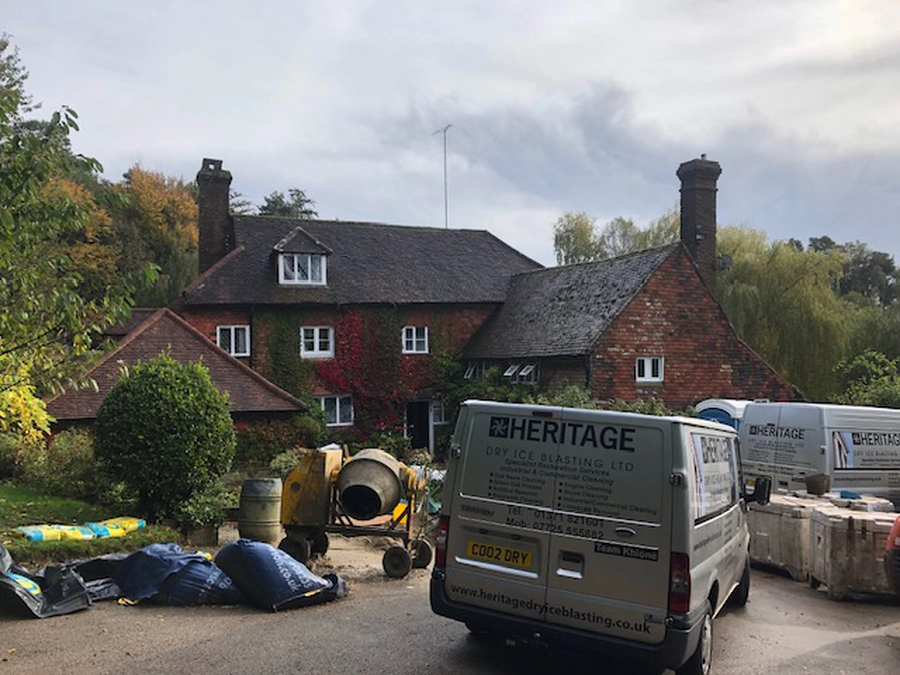
A remarkable restoration project at the former home of A.A. Milne and Brian Jones
There are restoration projects, and then there are projects that give you the opportunity to become part of history.
Our recent work at the beautiful Cotchford Farm was certainly one of the latter.
Situated in East Sussex, Cotchford Farm is a property steeped in history. It was once the family home of celebrated author A.A. Milne, creator of Winnie-the-Pooh, and his son Christopher Robin. The property was later home to Brian Jones, founding member of The Rolling Stones.
For our team, being invited to undertake restoration work at such a historically significant property was a real privilege.
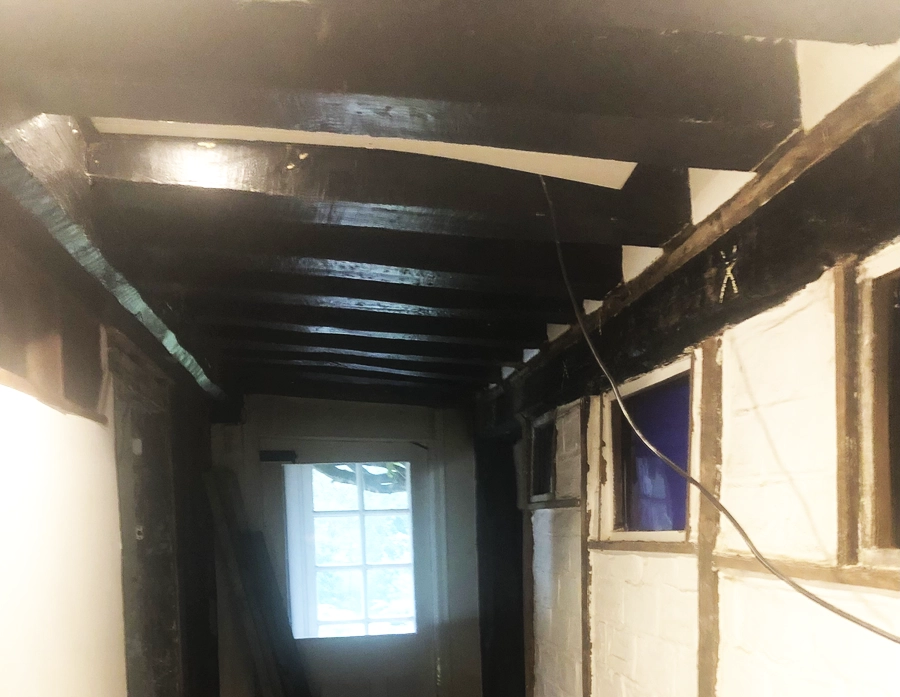
Restoring a room with a remarkable past
One of the most special areas of the property is the sitting room, famously associated with photographs of A.A. Milne and his son Christopher Robin.
Looking at the room in its original condition, it was clear that considerable care would be needed to bring the beautiful original timberwork back to life.
The exposed beams and structural timbers are an important part of the property’s character. Years of age, accumulated dirt and previous treatments had left the surfaces looking tired and obscured much of their natural appearance.
The challenge was to restore the timber while respecting the age, character and historic fabric of the building.
Why dry ice blasting?
We used our specialist dry ice blasting process as part of the restoration.
Dry ice blasting is particularly suited to sensitive restoration projects because it uses solid carbon dioxide pellets rather than conventional abrasive materials.
The process works through a combination of thermal shock and controlled impact, helping to dislodge unwanted surface contamination without introducing water or conventional blasting media.
This offers several advantages when working with historic timber:
- No water is introduced during the cleaning process.
- No conventional abrasive blasting media is left behind.
- The process is non-abrasive in principle, helping retain the original timber profile and detail when correctly specified and controlled.
- Intricate surfaces, joints and exposed beam details can be treated.
- It provides an alternative to aggressive sanding and chemical stripping methods.
Every historic building presents its own challenges, and the correct blasting settings and technique are essential to achieving the best possible result.
Respecting the history, revealing the character
The transformation of the room demonstrates just how important the original timberwork is to the overall appearance of a historic property.
By carefully restoring the exposed beams and surrounding features, the natural character of the building can once again become the focal point.
For us, this is what restoration is all about: not simply cleaning a surface, but helping to preserve the features that make a building unique.
A project to remember
At Cotchford Farm, we were reminded that our work often involves much more than simply restoring timber and masonry.
We are fortunate to work in some truly remarkable buildings, and occasionally we get the opportunity to work in places that have played a part in cultural and literary history.
To have our team and restoration equipment on site at the former home of A.A. Milne and Brian Jones was a particularly memorable experience.
We are incredibly proud to have played a part in the restoration of this special property.
Preserving the past. Revealing the beauty. Restoring for the future.
Specialist dry ice blasting and restoration – helping historic buildings retain their character for generations to come.